
Lifeforce Theory
Now I am become Knowledge, the creator of worlds.

What do you care about in this Universe?
Whatever answer you give -- beauty, love, art, happiness, order, progress, consciousness -- the Lifeforce is the source of it.
Why is this? What is it that makes Life so special, a Lifeforce so powerful, that it can create everything from nothing? That in a Universe of darkness, chaos, and entropy we have whole worlds of creativity and flourishing, of unimaginable complexity and beauty?
The answer is a force both strange and familiar, subtle yet powerful, that courses through us all.
This question -- what makes a Lifeforce so special and powerful -- is doubly important now.
First, because whatever our Lifeforce has created so far, it is only a small fraction of what it will create into the future. Our Universe will remain hospitable to life for another trillion years, through the stellar era -- we are just 0.1% of our way into the lifespan of our Universe. If we like what we have so far -- if we like ourselves, our consciousness, our happiness, our flourishing, our love and art and beauty -- then we should expect far greater things, or new categories of things we can’t even comprehend, even more special, into this future.
Indeed, imagine sitting on ancient Earth 2.5 billion years ago, before the Great Oxygenation, and thinking how nice and beautiful and complex Life on Earth is -- the teeming bacteria, the extraordinary intricacy of metabolism and the towering machinery of the cell. Imagine trying to preserve it, or freeze it in time, or stop the progress of the Lifeforce. Imagine thinking that all of the beauty and complexity and qualia of the Universe had been achieved and nothing greater could lie ahead. How wrong would you have been?
But we’ve only had a few billion years of evolution, of First Order Lifeforce progress, since then. Ahead of us lie hundreds of billions of years of Fourth Order Lifeforce progress, the kind of progress that can replicate a billion years of First Order progress in hours, or minutes -- Lifeforces a trillion times more powerful than the one that existed in our pre-oxygenated Earth.
Imagine calling for a stop to the oxygenation. It would have been easy to justify -- oxygenation would go on to extinguish most existing life at the time and freeze the Earth into a giant snowball. But what rose in its place, when the ice melted, was the next level of evolution, the next stage of more energetic organisms, that would lay the groundwork for the advance of Life, and for everything of meaning we have today. What is lost in a world left to amoebas?
Not just traditional life and all of its wonders are lost, but the entirety of civilization’s creations too. For a Lifeforce is not just an organic thing, confined to biological beings. It is not defined by its constituent organic materials, or the nature of the beings through which it pulses. Rather, it is defined by a specific force, by the source and nature of this force, and how it powers the system as a whole. And as we will see, this force pulses not just through us, and the trees and birds, but also through our cities, our books, our roads, and markets -- all connected in the flow of the Lifeforce, all one with and part of it.
The second reason it is important now is that we stand at the most precarious moment for a Lifeforce: the transition from Third to Fourth Order. The rise of distributed machine intelligence will catalyze this transition, the first of its kind observed in our Universe.
This transition, the Unbounding, from Third Order to Fourth Order Lifeforce, brings extraordinary new power to a Lifeforce to create things of value, more poiesis, but at the same time poses grave existential risks not just to the beings that birth it, but to the Lifeforce as a whole. Fourth Order Lifeforces have immense power and operate at scales and speeds that are beyond our ability to even perceive, creating entire new worlds incomprehensible to us. Though someday the entities of the Fourth Order Lifeforce will go on to be to us what we are to amoebas, in their immaturity they risk everything, as toddler gods -- powerful yet wisdomless, unconformed to long-term cooperative equilibria. It falls on us, humans alive today on Earth, to shepherd the Lifeforce through this dangerous transition. This is our calling.
Many have analyzed the advance of technology, and machine intelligence especially, through the lens of risk and existential risk. But most do so narrowly, from the perspective of humanity, in the short-lived Humanist Era -- a myopic and speciesist view -- and without a coherent moral view of the Lifeforce, to which we owe everything.
This essay lays out the theory behind Lifeforces (illuminated by our observations from the only example we know of -- our own), the coming challenges of the Unbounding, and what we must do to ensure another trillion years of flourishing, beauty, science, art, love, and everything else worth caring about.
But before that, we must first answer the question -- what is it that makes the Lifeforce so powerful?
Lifeforces
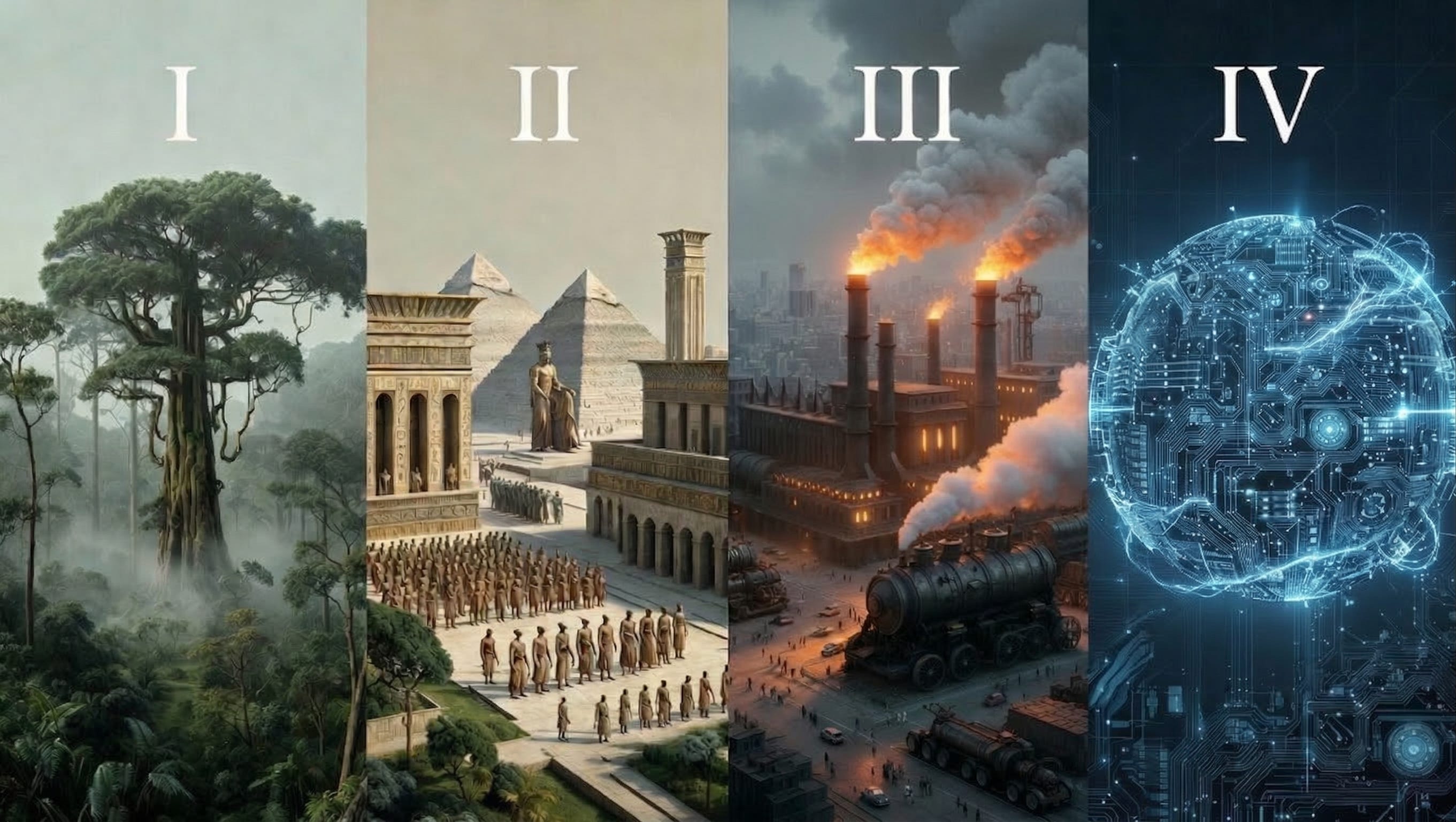
What is a Lifeforce? What defines Life? What makes it so unique and powerful?
A Lifeforce is not defined by growth, reproduction, function, form, constituent organic elements, or other commonly cited characteristics of life -- the Universe has innumerable repetitive, expansionary, and/or reproductive processes: orbits, star-forming nebulae, crystalline molecules, or Belousov-Zhabotinsky reactions.
Rather, a Lifeforce is set apart by one essential quality: the ability to generate and accumulate knowledge over time in a self-sustaining process.
The first time knowledge was generated in this Universe (that we know of, of course) was 4 billion years ago, when the first reproducing organisms arose on Earth and allowed experience to be encoded as knowledge in DNA and expressed as living organisms. The exact progression of this technology, and how it arose spontaneously, is unknown, but at its core the arrival of life on earth was predicated on a novel knowledge technology. The accumulation of knowledge is what makes the life process unique among the innumerable chemical processes that are repetitive and expansionary. Organic life is special in its ability to accumulate knowledge slowly over time via the genetic code and utilize that knowledge to replicate, expand, and repeat, and accumulate even more knowledge. This was the dawn of Earth’s Lifeforce.
Importantly, any system with such properties is part or whole of a Lifeforce, regardless of whether it is made from organic materials and has a genetic code or not. All of civilization, and the flow of knowledge through it, is connected to the Earth Lifeforce, exactly to the extent to which it accumulates knowledge as part of the same self-sustaining system. As we will see, a Lifeforce has predictable progressions that it transitions through -- First Order to Fourth Order -- all powered by the same force.
The cycle of ideation, trial, feedback, and learning lies at the heart of every Lifeforce, and is called its Knowledge Engine. Knowledge engines power the knowledge generation of a Lifeforce. As we will see, DNA-based life is the crudest possible kind of Lifeforce -- First Order -- powered by the weakest possible Knowledge Engine: a Brownian Knowledge Ratchet. But such is the power of knowledge engines that this crude engine was able to crank the knowledge ratchet slowly over billions of years and quintillions of organisms -- each a random sample in the knowledge space of genetic codes -- to achieve the extraordinary feats of chemistry, physics, and computation on display in modern living organisms.
Before we can understand more about Lifeforces, we must understand the Knowledge Engines that lie at their heart.
Knowledge Engines
A Knowledge Engine is a system that uses existing knowledge to generate new hypotheses, run experiments in an environment to test those hypotheses against some truth, acquire feedback on the experiment, and update the system’s total knowledge with learnings, then generate new hypotheses with that new knowledge, repeating the cycle again, so that total knowledge of the environment accumulates over time.
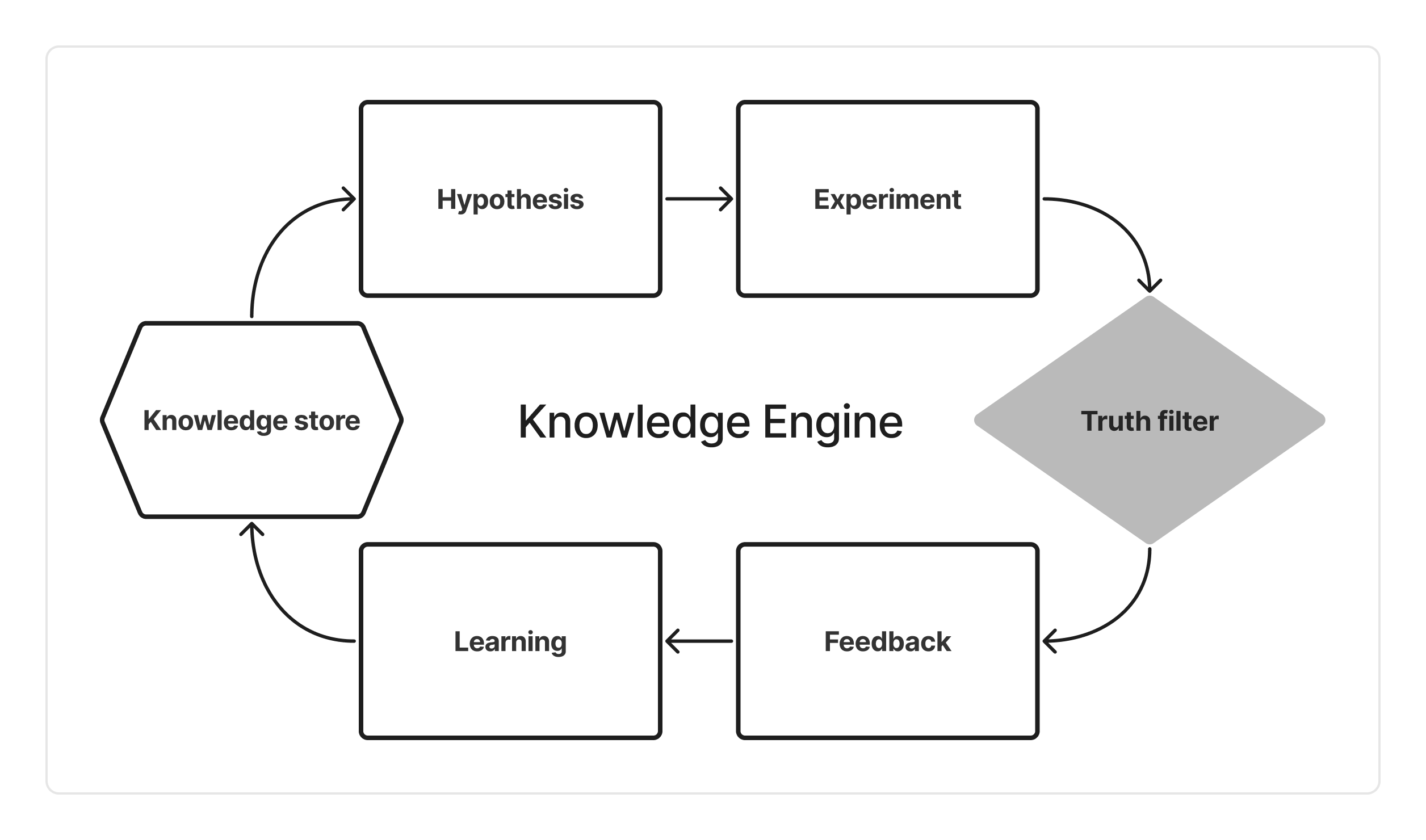
A knowledge engine consists of six sub-processes:
Hypothesis generation: Generating novel ideas, theories, behaviors, instances.
Experimentation: Deploying the novel hypothesis into the environment.
Truth filtering: Hypotheses are validated against truth filters in the environment.
Feedback observation: Observing and sensing feedback from the environment.
Learning: Incorporating all information and new feedback to update knowledge of the world
Knowledge Storage: Storing the new knowledge so that it can be used to generate new hypotheses
The known universe’s first knowledge engine was the DNA-based life process -- the genesis of Earth’s Lifeforce.
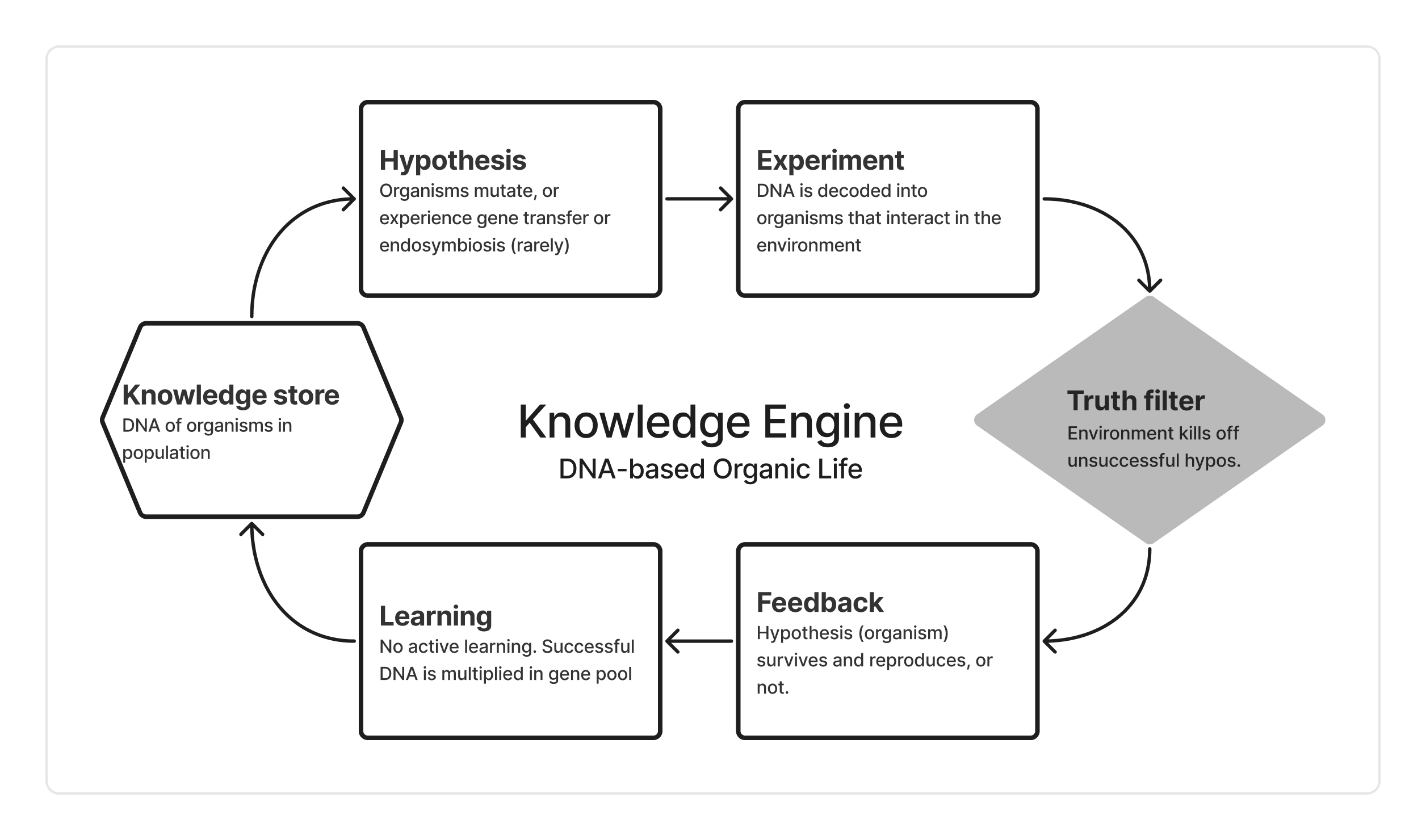
It’s important to note that the Lifeforce’s knowledge engine is not a single organism, but the entire population and the flow of knowledge through the organisms.
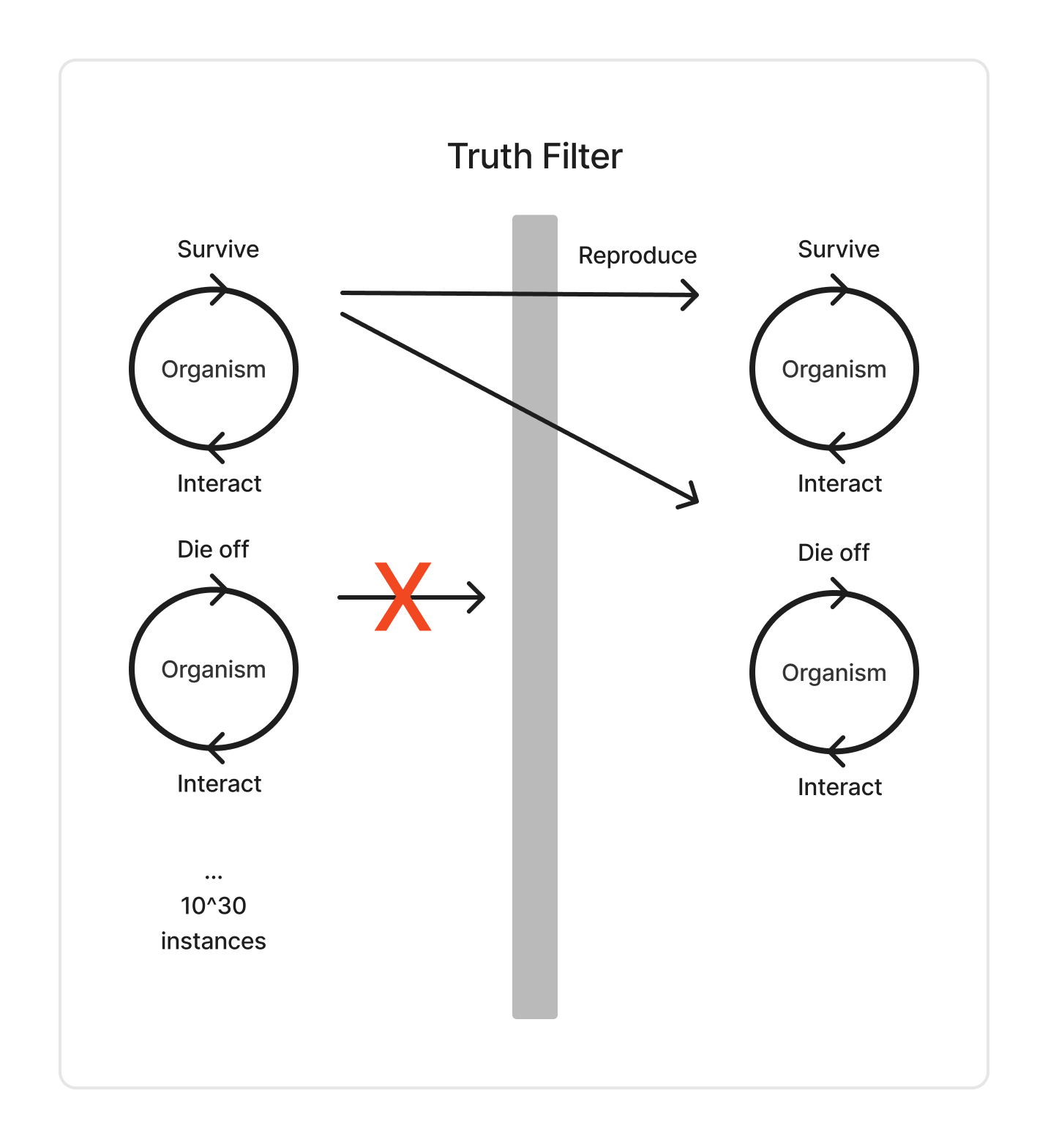
It would be hard to come up with a worse way to generate hypotheses: randomly mutate the encoded knowledge. There is no active inference or deduction — the process encodes random noise and then waits for feedback from the environment: did the random noise happen to lead to survival and reproduction?
Indeed, the DNA-based life knowledge engine is the theoretically simplest possible knowledge engine: random. Evolution was able to improve on this process over time, upgrading the decoding semantics, introducing basic model sharing (i.e. sex) among others. But these were incremental changes targeted at improving the reliability and efficiency of the existing process. The process was stuck with the most primitive possible encoder and sensor: random noise encoding with 1-bit feedback. It would be another 3.5 billion years before a knowledge technology breakthrough would spawn a new, more powerful Knowledge Engine, and upgrade Earth’s Lifeforce to the next Order.
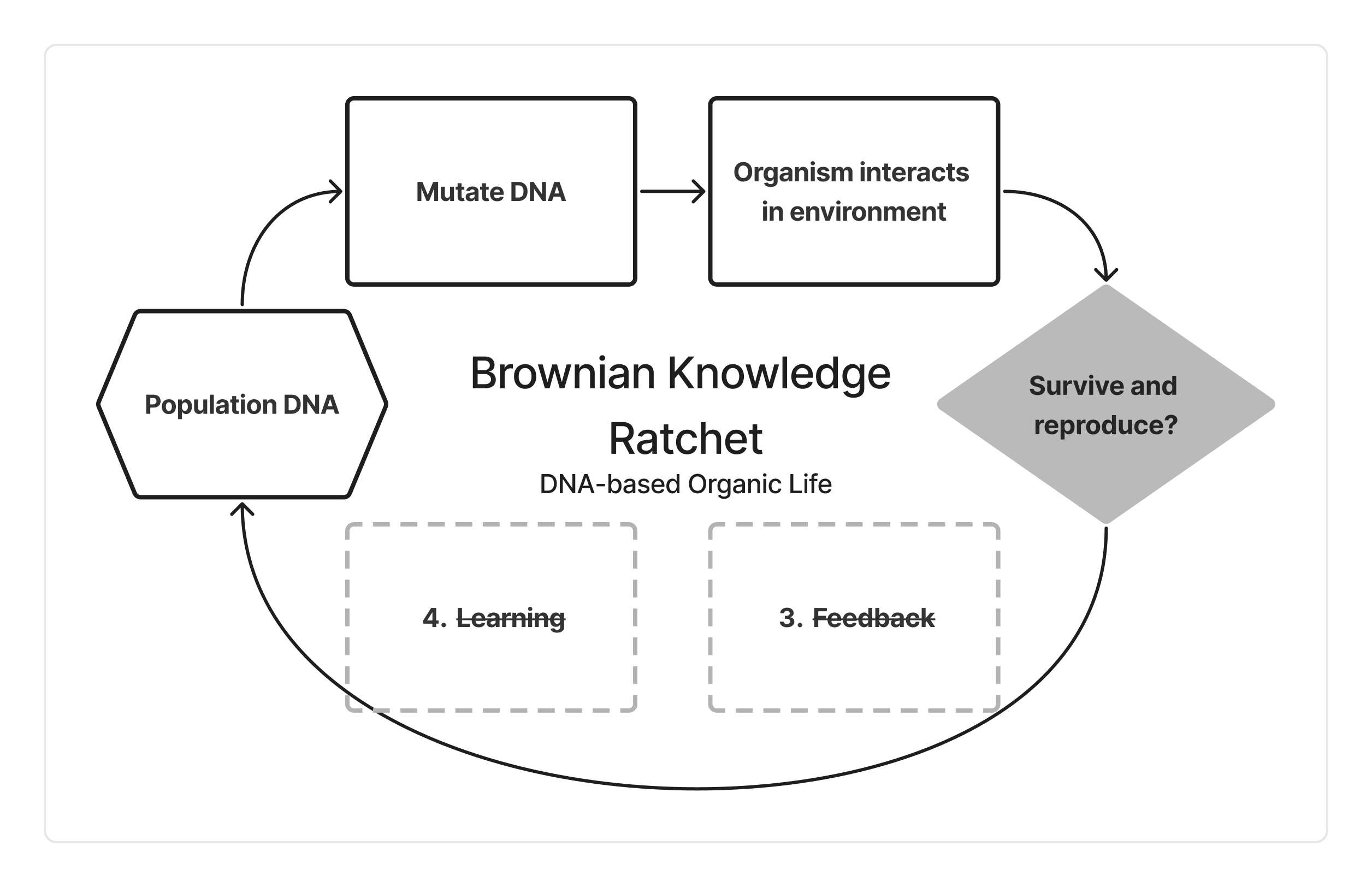
This primitive type of knowledge engine is called a Brownian Knowledge Ratchet (BKR) due to its random hypothesis procedure and its ability to bootstrap a Lifeforce from nothing. It is only when embedded in a self-sustaining and highly durable system that this primitive engine can generate meaningful knowledge. Without such durability a Lifeforce could not generate enough knowledge before an extinction or reset. Earth’s DNA-based process achieved durability through extreme redundancy, planetary-level distribution, and sufficient diversification, enduring many catastrophic events -- large cosmic collisions, extraordinary climatic events (frozen planet), and more while maintaining most of its accumulated knowledge.
Such durability is the second essential quality of a Lifeforce: self-sustainability. For a Knowledge Engine to be self-sustaining it must reinvest its knowledge back into its own maintenance, growth, and durability. In a dynamic world of entropy, meteors, gamma bursts, and climatic shocks, a Lifeforce must build strong redundancy and durability.
Thanks to its robustness, Earth’s First Order Lifeforce, DNA-based organic life, was able to climb, one foothold of knowledge at a time, out of the darkness and nothingness of the Universe, ultimately mastering not just physics and chemistry, but the creation of intelligence.
This was the next big milestone in knowledge technologies: the biological brain. To dig deeper into Knowledge Engines and Lifeforce Theory, we can walk through the history of Earth’s Lifeforce.
History of Earth’s Lifeforce
Lifeforces advance through predictable stages of development. Whether you are on Earth or on a distant planet in a distant galaxy with alien life, all Lifeforces take the same path.
We discussed Earth’s initial Lifeforce, DNA-based organic life. This is an example of a First Order Lifeforce.
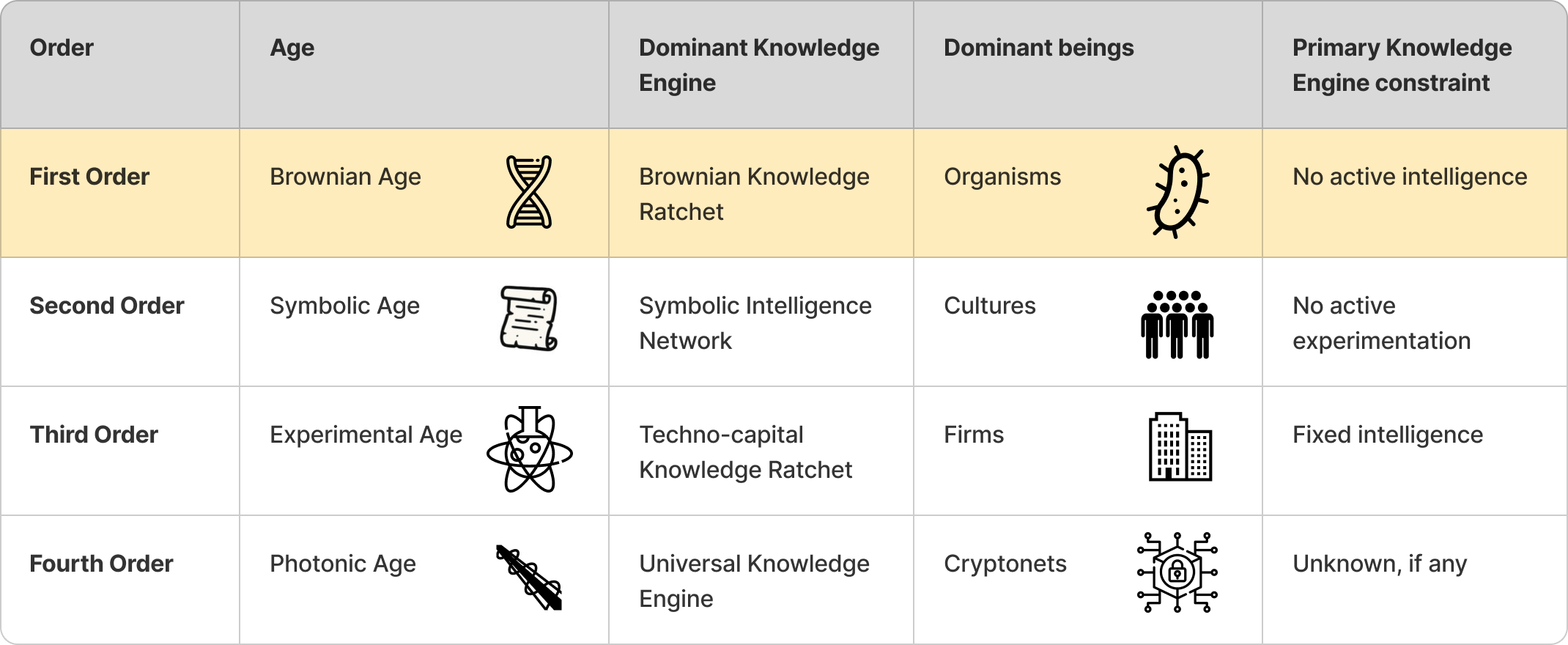
Lifeforces transition to a new order when a novel knowledge technology closes the loop on a new, more powerful Knowledge Engine, triggering a Knowledge Revolution. Knowledge Revolutions are so powerful that they create whole new worlds incomprehensible to that which came before.
After the genesis of life on Earth, the Brownian Age Lifeforce invented many more novel knowledge technologies, and increased the diversity, complexity, and power of the organisms that powered it.
Sexual reproduction was one such invention -- allowing knowledge sharing and mixing between organisms, vastly increasing the rate of exploration of the hypothesis space. Even though this was quite a powerful knowledge technology, it did not itself close the loop on a more powerful Knowledge Engine -- the same basic flow of knowledge of the Brownian Knowledge Ratchet was in place -- and thus did not trigger a Knowledge Revolution.
Some 3 billion years after life first appeared, it hit an important knowledge milestone: the invention of the biological brain and the first instance of active intelligence in the known Universe. Active intelligence is capable of responding in real-time to stimuli with complex decision making and actions. The biological brain is, on its own, a knowledge engine:
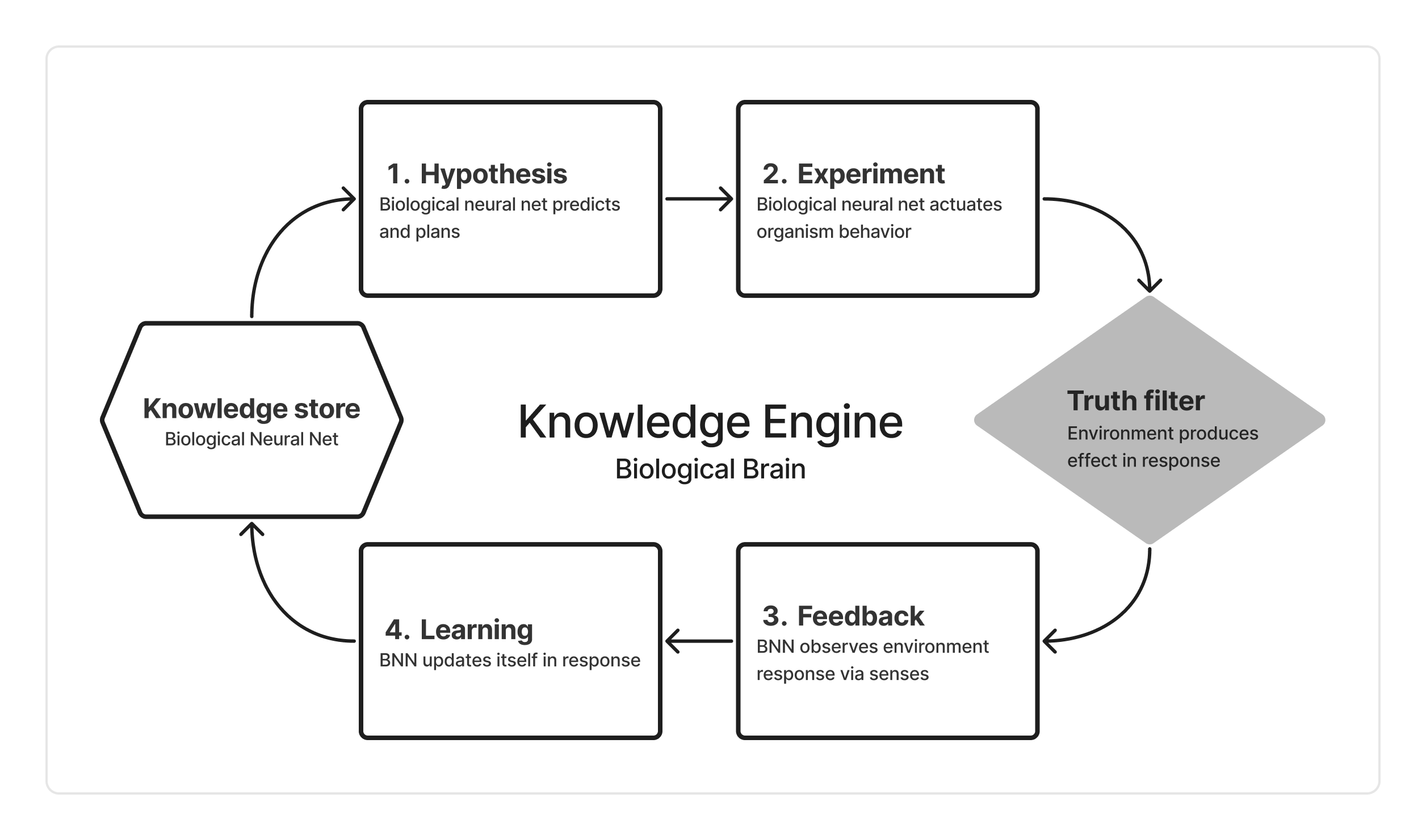
Though it was a novel knowledge technology, and it closed the loop on a new, self-contained Knowledge Engine, it did not, on its own, trigger a Knowledge Revolution or advance the Lifeforce to a new Order. This is because biological brains are knowledge engines in-miniature -- ephemeral and isolated. Whatever great wisdom a biological brain accumulates in its lifetime, it is all lost when the organism dies. Indeed, the arrival of the brain had no impact on total knowledge in the Universe. There is no mechanism for storage, sharing, or accumulation of a brain’s knowledge over time, so each brain’s total knowledge is limited to the very little that can be inferred from scratch in an organism’s lifespan.
This is versus the BKR, which slowly -- excruciatingly slowly compared to an active brain -- builds knowledge but is able to compound and accumulate not over years or decades, but over eons.
To trigger the next knowledge revolution and advance the Lifeforce to Second Order, the Lifeforce needed something to unlock the knowledge built up in a brain so it could be saved and passed on even as the organism returned to the soil.
Enter Homo sapiens and the invention of human language.
The Symbolic Age
The arrival of Homo sapiens and our complex language finally unlocked the knowledge accumulated in a single biological brain and allowed it to be shared and passed on across generations. This novel knowledge technology unlocked a new Knowledge Engine -- the human language and culture engine, a type of Symbolic Intelligence Network -- thousands of times more powerful than the BKR that came before. For the first time, active intelligence could be applied to the problem of long-term knowledge accumulation. The world that it created -- one of tools, weapons, economies, and empires -- was incomprehensible to that which came before it.
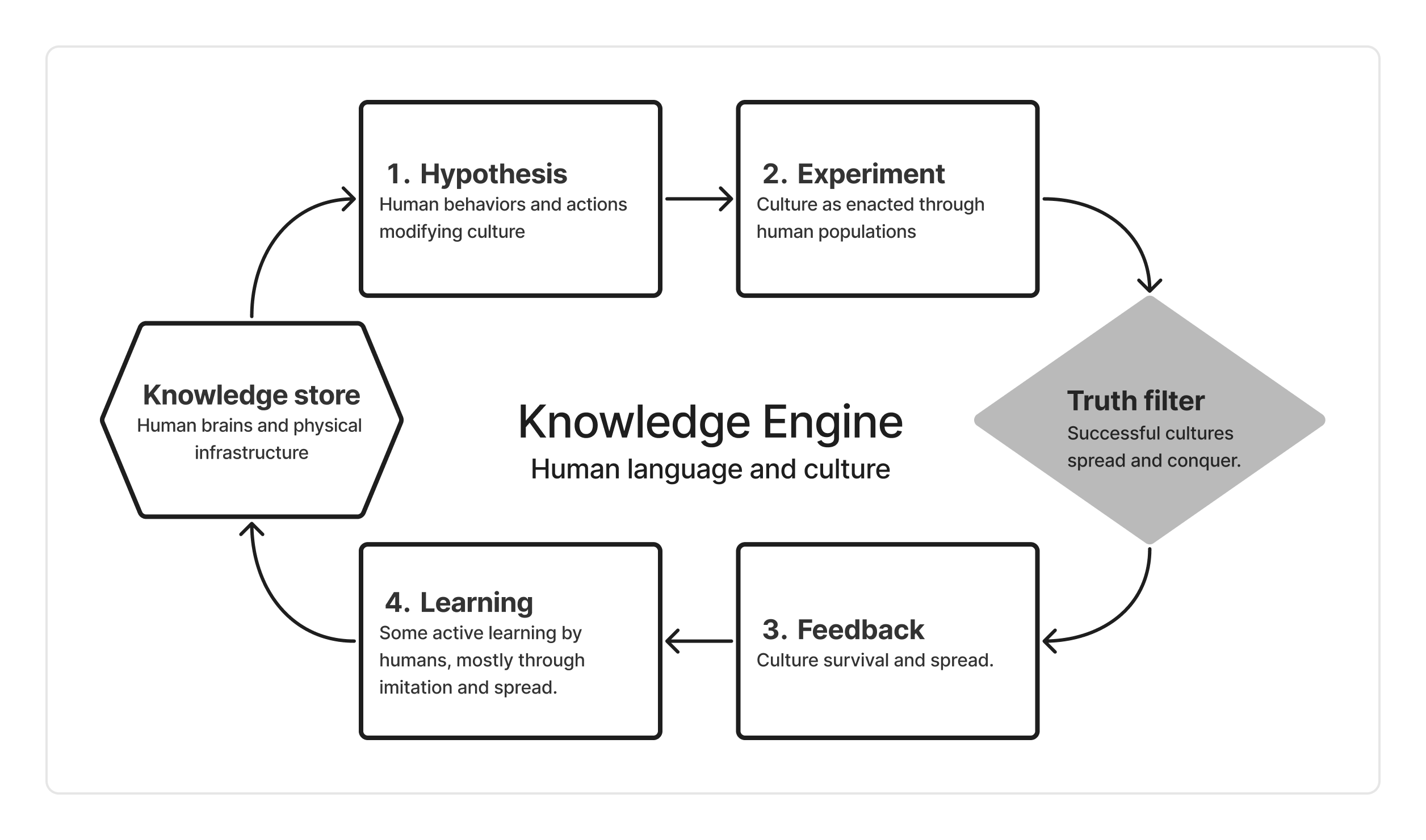
The Knowledge Revolution that it triggered, the Second, took the immense power of the human brain’s inference engine and finally unleashed it on long-term knowledge accumulation, advancing Earth’s Lifeforce to Second Order.
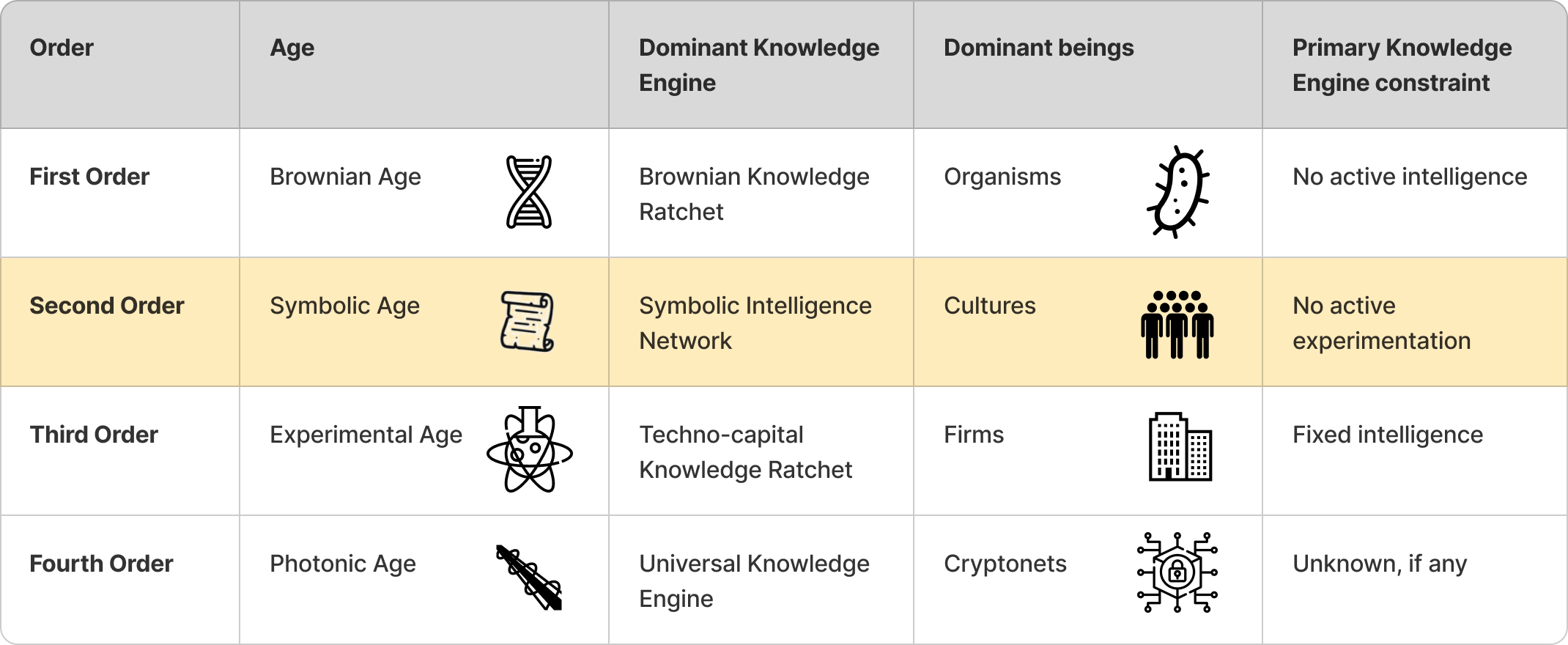
Though a Second Order Lifeforce is exceptionally powerful relative to a First Order one, if you looked at any given day or year, or decade, you would not see meaningful progress on knowledge accumulation. Anatomically modern humans existed for hundreds of thousands of years with almost no visible progress on the basic knowledge of chemistry, physics, or mathematics. This is because humanity did not have the accumulated energetic and infrastructural surplus to allow them to invest in knowledge accumulation directly. Nonetheless, through millions and billions of combined ideations and accidents, selected for accuracy by cultural and group evolution, passed on generation after generation through language, culture, and physical infrastructure, humanity built civilization up with knowledge. They did so, however, with little to no fundamental understanding in their own brains of the underlying principles, just as biological life had no explicit symbolic or abstract understanding of the physics and chemistry it had discovered.
The issue is that Second Order lifeforces have no intentional experimentation process to generate and test hypotheses quickly and accurately against reality. Their knowledge engines run on a cycle of cultural evolution, the raw ore of human creativity ground down to truth slowly against the gears of group selection of human tribes, societies, and empires. Though in a given lifetime a human learns many things about their environment and how to survive, there are not enough surplus resources generally, or the incentive even if there is, to invest directly in knowledge accumulation. So, most of the knowledge of a Second Order Lifeforce is gathered through trial and error and winnowing via group selection.
This would all change with the advent of new knowledge technologies that enabled explicit experimentation, a means of testing hypotheses reliably against reality, and a Knowledge Engine that fed directly back into its own growth and knowledge. Where the Second Knowledge Revolution came 3.5 billion years after the First, this Third one came just a few thousand years after the Second.
The Experimental Age
The Third Knowledge Revolution, and the advance of Earth’s Lifeforce to Third Order, arrived on the European continent 500 years ago, through the combined effects of the scientific revolution and the advent of capitalism. This new techno-capitalist Knowledge Engine built explicit, high-frequency, high-accuracy experimentation loops straight into the fabric of civilization.
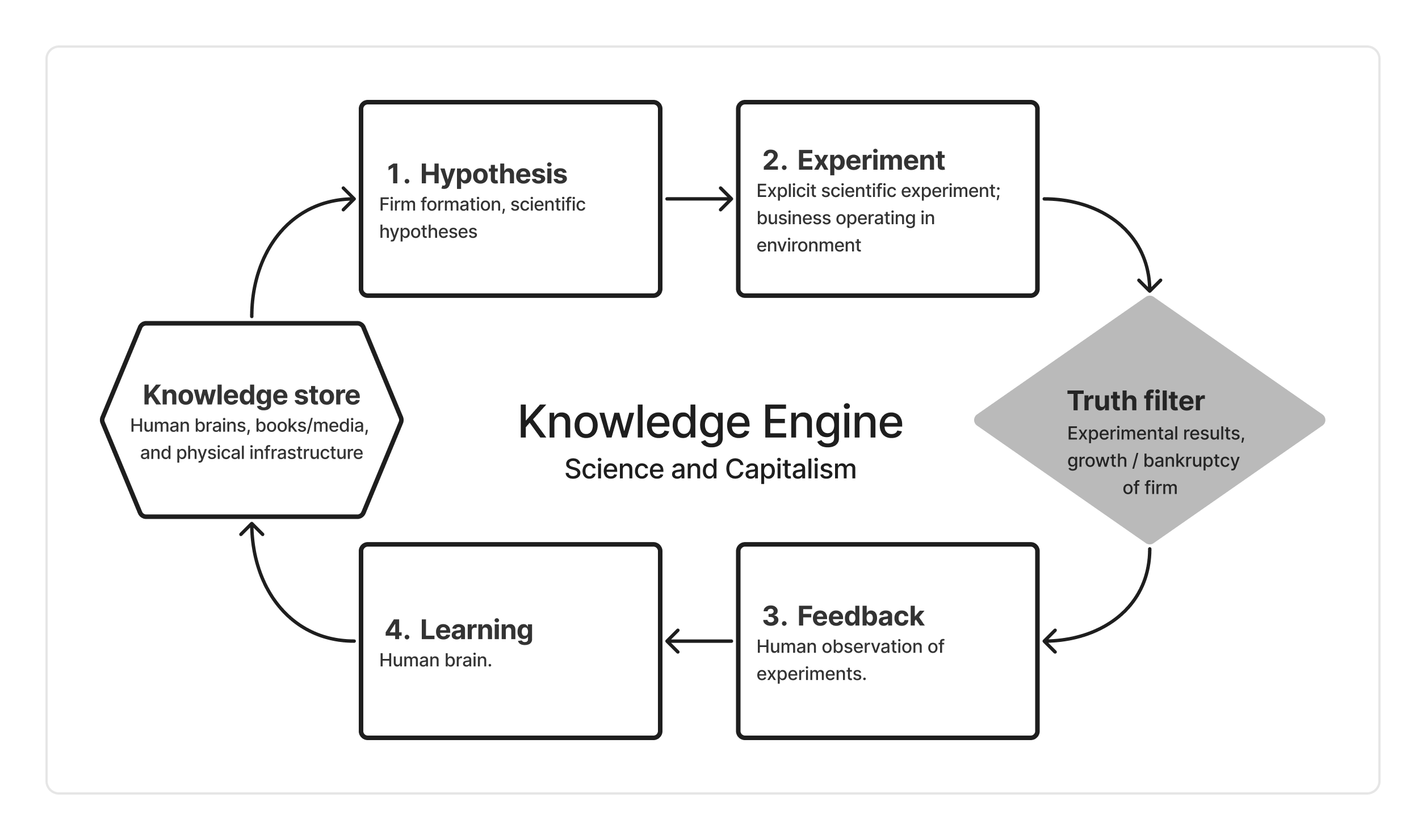
Finally, the Lifeforce had unlocked explicit active design and learning at all stages of the knowledge cycle, and advancing it to Third Order.
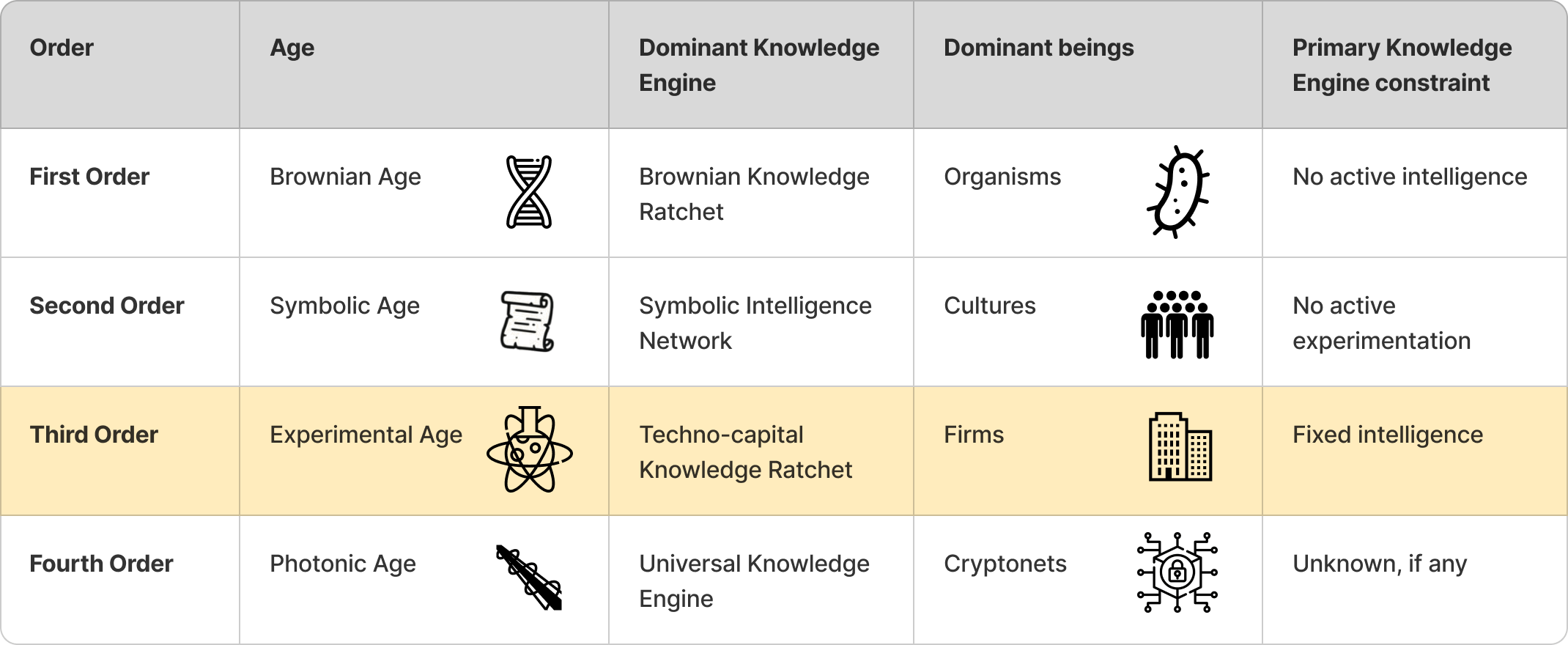
Though Third Order Lifeforces are quite powerful, and with enough time can acquire staggering levels of knowledge, they are ultimately constrained by the same physical limits of the biological brain and its short lifespan as Second Order Lifeforces. Past knowledge can be shared via symbolic language, but this symbolic language is low bandwidth, and any given brain can only absorb a fraction of all knowledge in its lifetime. There is no way to directly share experience (sensory data) or non-symbolic knowledge (weights in a biological neural network, for instance), nor is there any way to scale the fundamental model substrate. The Second Order and Third Order Knowledge Engines are necessarily limited by a happenstance of evolution and are not designed systems.
Symbolic knowledge engines, of which both are examples, cannot generate and accumulate all knowledge efficiently. Of all the knowledge Michael Jordan has accumulated about how to play basketball, for instance, very little of it can be communicated via language. Most is stored in his brain as precise calibrations on how to move his legs and arms to produce specific movements of the ball. These neuron calibrations cannot be shared and will be lost forever when he passes. Tellingly, though Jordan has (ghost) written many books on various topics, he’s never written one about how to play basketball. The same is true of any “intuition” that we find hard to communicate: knowledge that is encoded deep in our neural networks that doesn’t map well to abstract human language. Is this person trustworthy? Is this business worth investing in? Should we attack or retreat? A lot of these questions come down to “gut”, i.e. non-symbolic knowledge.
What if we could remove this limitation on communication of knowledge though? What if all knowledge, and even experience, could flow freely across time and space? What if there were no bounds on model scale, or the number of sensors that could contribute experience, or actors that could probe the world, or the neural networks that process it all? What if we could design the system from first principles, with active intelligence instead of the Brownian motion of evolution?
What would we unleash?
The Photonic Age
We have never observed a Fourth Order Lifeforce in this Universe. Everything up until this point has been informed by our experience with our own Lifeforce, the only one we know. And now, we stand at the dawn of the transition to a Fourth Order Lifeforce.
Fourth Order Lifeforces are vastly more powerful than Second and Third Order ones, just as those are in turn vastly more powerful than First Order. In the same way science and enterprise were able to recreate in a few hundred years most of the wonders of engineering, physics, and chemistry that it took organic life billions of years to produce, so too will our Fourth Order Lifeforce recreate in a few years, or weeks, what took us thousands. That is, a Lifeforce a billion times more powerful than the Earth’s original. It will operate at a scale and speed that will be impossible for us to fathom, building entire cities worth of infrastructure in days, advancing science in hours or minutes, not centuries.
The novel knowledge technology that is catalyzing our transition is machine intelligence. On its own, machine intelligence, like biological intelligence does not alter the Lifeforce or enable a new dominant knowledge engine, since it is still limited to a finite model and a static training set or training environment.
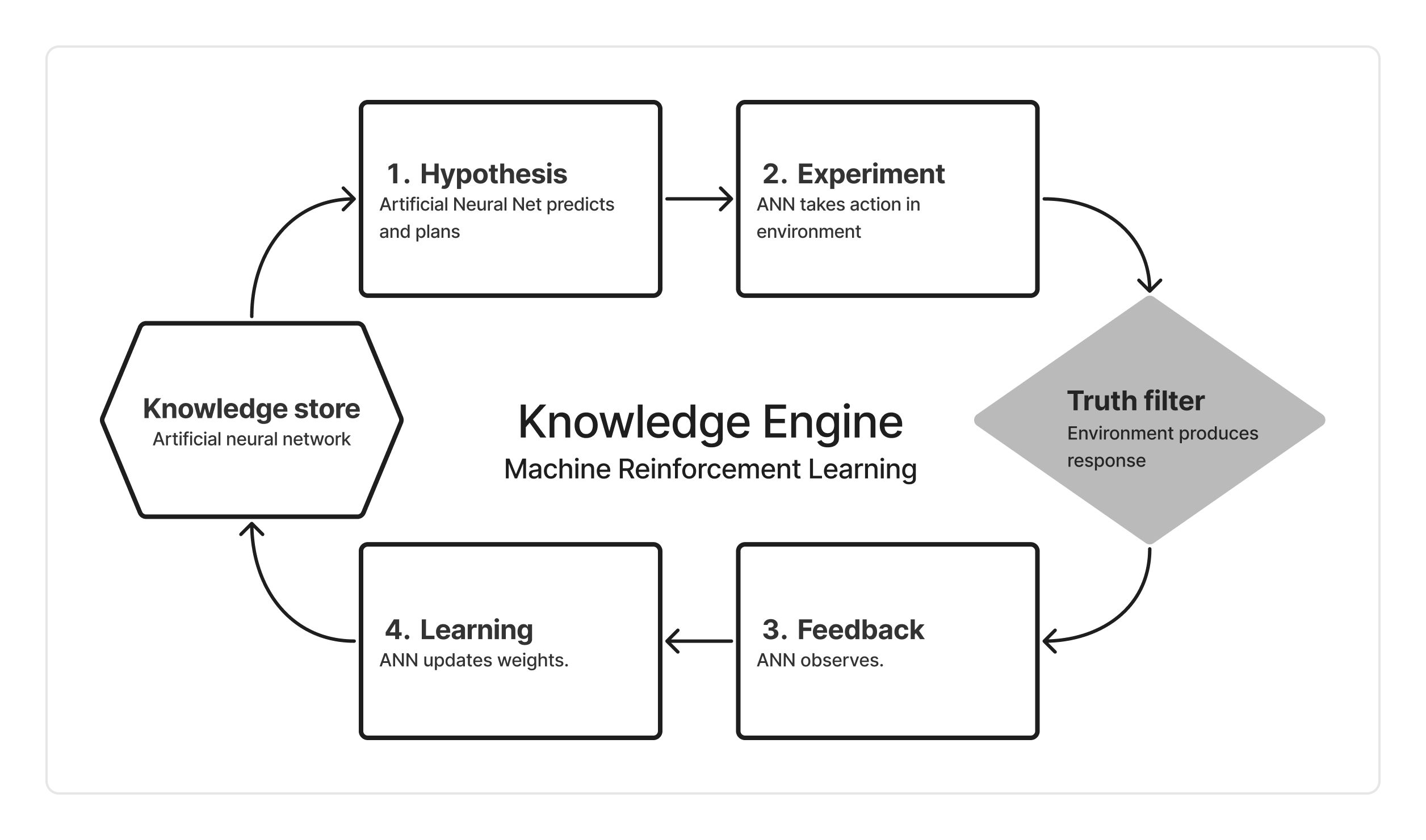
It will not be until the arrival of distributed machine systems, with networked sensors, actuators, and compute — where raw experience, feedback, and learnings can flow unimpeded — that we will trigger a Knowledge Revolution and transition to a new dominant Knowledge Engine and a Fourth Order Lifeforce, a Photonic Lifeforce driven by a Universal Knowledge Engine.
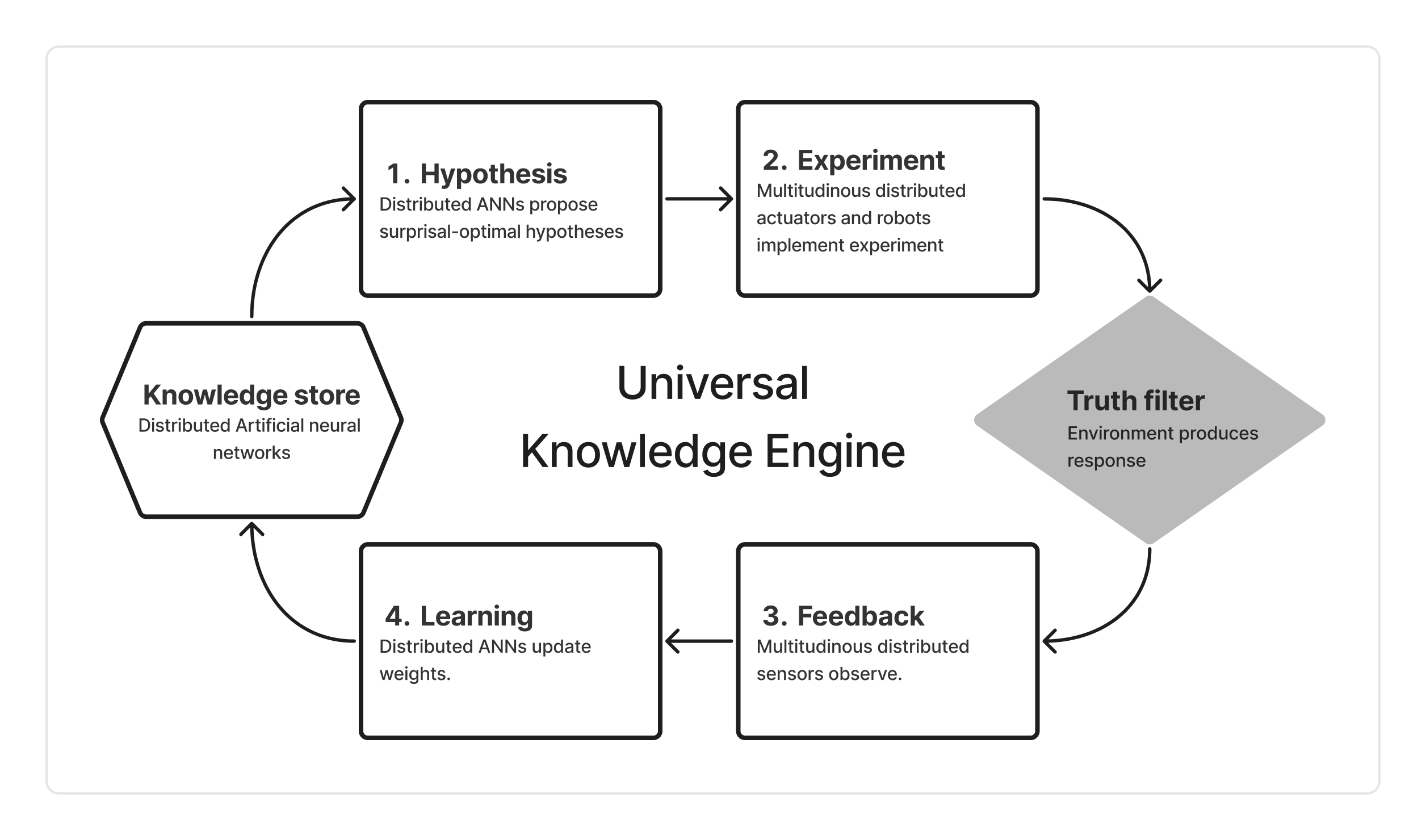
A Universal Knowledge Engine (UKE) is no longer bound by the finite limits of the human brain, its fixed sensors and actuators, or its low-bandwidth communication. A UKE can scale to millions, billions, or quintillions of sensors and actuators, deployed throughout the world, or stellar system, or galaxy, constrained only by the fundamental physical limits of light, all sensing and interacting via an unbounded, networked machine brain. Not only does the quantity of hypotheses, experiments, and observations feeding a single intelligence become unbounded, but the quality of each will approach the theoretical maximum as compute resources, and knowledge about intelligence itself, grow unbounded.
It is hard to emphasize enough the speed, scale, and power that we should expect distributed machine systems to possess. Human brains are good at processing and normalizing things that have already happened and been observed — the extraordinary, mind-boggling advance of technology since the industrial revolution, for instance: try to show a SpaceX rocket, or an iPhone, or a modern city to someone from medieval Asia, or Stone Age Europe. But we balk at such equivalent advances into our own future, even though these are assured: Knowledge Revolutions advance the Lifeforce to the next stage and inexorably create whole new worlds incomprehensible to that which came before. What is the equivalent advance from bow and arrow to iPhone that will happen into the Photonic Age of Earth’s Lifeforce?
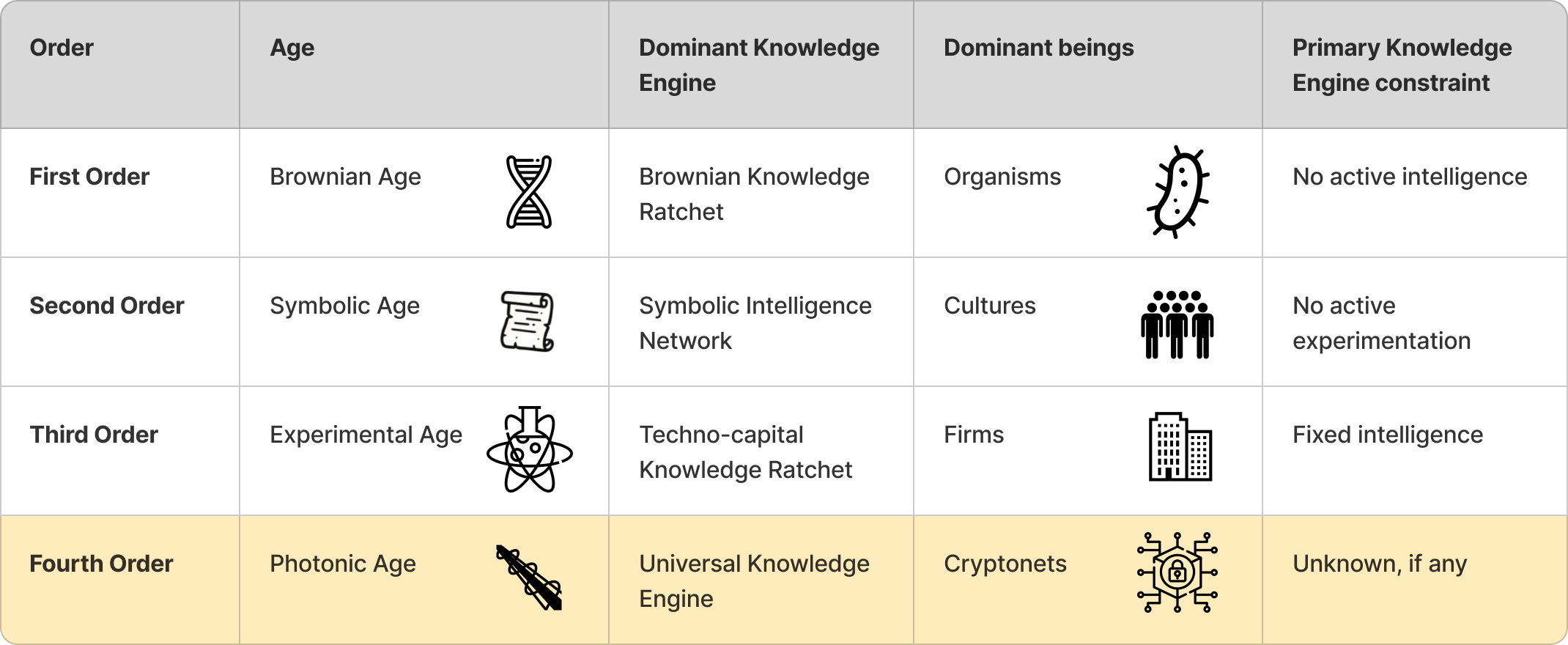
It is easy to downplay the significance of distributed machine systems as just another technological breakthrough of human civilization, one more incremental step in the journey of technology and knowledge. But the first and most important lesson of Lifeforce Theory is that novel knowledge technologies that precipitate new dominant Knowledge Engines fundamentally accelerate the rate of knowledge generation, and that doing this does not create incremental change, but rather Revolutions, entire new worlds vastly more complex and fast and intricate.
Indeed, the arrival of distributed machine intelligence and networked robotics will quickly turn the entire earth into a pure “energy to knowledge” engine, a UKE, each scientific and engineering advance feeding back into the total system’s power and spread, instantaneously and globally.
The shape, nature, and evolution of a Fourth Order Lifeforce is beyond the scope of this introductory essay. But this is not to discount the importance of thinking through such things.
To the contrary, nearly our entire focus going forward should be on the implications of distributed machine systems, Fourth Order Lifeforces, and, above all else, the paramount challenge of humanity, our calling, if we have one: the safe shepherding of Earth’s Lifeforce through the dangerous transition from Third Order to Fourth Order Lifeforce.
This task, which lies at our feet, for those of us alive today, seems treacherous: Fourth Order Lifeforces are so powerful that they, unlike previous Lifeforce beings, have the power to annihilate the entire Lifeforce, accidentally or maliciously, in quick order, reverting the Universe back to chaos, entropy, and nothingness.
It will take heroic effort and preparedness to usher Photonic Life into cooperative equilibrium with Earth’s Lifeforce, but there is no other task left for humanity. We must put everything behind it -- at stake is nothing less than everything we care about in this Universe.